Spider People
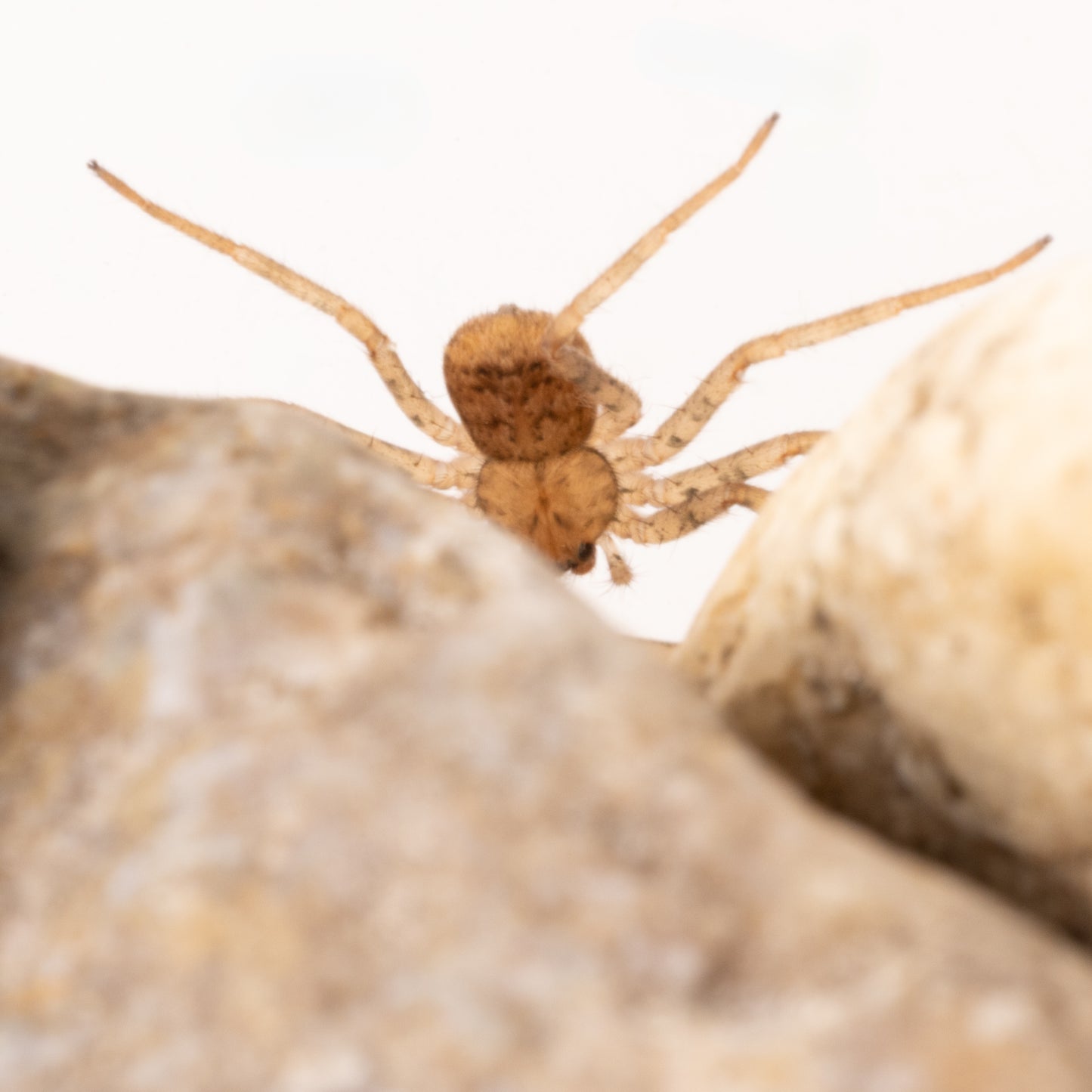
Selenops radiatus (Tomb Crawler aka Flatty)
Selenops radiatus (Tomb Crawler aka Flatty)
Couldn't load pickup availability
There’s a reason flatties aren’t common in the hobby. They have short lifespans (males ~6 months, females ~12 months), are extremely fast, and don't tolerate sloppy setups or casual handling. They don’t sit in inventory well, they don’t forgive mistakes, and they'll exploit the tiniest gap you didn’t think mattered.
That said… we already love them.
Our first photo session with this species quickly turned into spider ninja training. We learned quick why the common name “Flatty” exists. It slid cleanly out from under a catch cup like it was nothing.
Speed and escape risk are the challenge here, not venom. Their venom is not considered medically significant to humans. The challenge is about preparation, containment, and respect for what this spider can do.
Our Approach to Husbandry
Because care information for this species is limited in the hobby, our setup is based on documented natural behavior and firsthand observation.
They're housed in an arid enclosure that reflects their natural habitat of rocks, walls, and tight crevices rather than burrows or webs. A sand base is used strictly to stabilize rock structures, not as a digging substrate. Flat rocks are stacked tightly and wedged into the sand to prevent shifting when the enclosure is moved and to avoid any chance of collapse or injury.
Tight, flat hiding spaces are intentional. This species is an ambush predator and spends most of its time pressed into crevices until prey moves nearby.
We mist occasionally for drinking only, not to raise humidity, mimicking morning dew rather than a damp environment. Disturbance is kept to a minimum because when startled, this spider will explode out of the rocks and bolt.
For feeding, we place the enclosure inside a larger bin treated with a Fluon barrier. We have tested this firsthand. The spider will not cross the vertical barrier, which is critical because they will attempt escape when disturbed.
Science Notes
This spider has been studied for its extreme rotational movement.
Rather than lunging forward, flatties pivot in place to face prey. Researchers have documented rotational pivot speeds of up to 3,000 degrees per second, a movement deemed the fastest leg-driven turning maneuver of any animal. They achieve this by anchoring one leg, pushing and pulling with the others, and tucking their legs inward mid-spin to increase rotational speed, similar to a figure skater.
These mechanics are now being studied to help inform robotics and machines designed to maneuver efficiently in tight, confined spaces.
California Academy of Sciences
This is not a beginner spider.
It's not slow.
It's not forgiving.
But it is creepy, impressive, chaotic, and fascinating.
If you’re brave enough, adventurer, they’re available for order. Good luck.
If not, we’re perfectly happy continuing our spider ninja training and raising them ourselves.
Share